
At first glance, scuba divers and astronauts seem to belong to completely different worlds.
One descends into the ocean. The other leaves Earth behind.
But the deeper you look, the more interesting the overlap becomes. Both enter environments humans are not naturally built to survive in. Both depend on specialised equipment, disciplined training, and calm decision-making. And in a surprisingly literal sense, both spend time learning how to move in conditions where normal body mechanics no longer apply.
So while one goes down and the other goes up, they actually have more in common than most people think.
What this article is for:
Curious travellers, new divers, and anyone who has ever wondered why scuba diving is sometimes compared to space exploration.
Key Takeaways
- Scuba divers and astronauts both operate in environments that require life-support systems
- Both rely on specialised suits, equipment, and procedural discipline
- Neutral buoyancy training plays an important role in preparing astronauts for work in space
- Pressure management matters in both diving and space operations
- The comparison is not perfect, but it reveals how human exploration often depends on similar principles
Both train for environments humans cannot naturally survive in
The most obvious similarity is also the most important.
Neither the ocean nor outer space is naturally survivable for us without support. Divers need breathing gas, thermal protection, buoyancy control, and a way to manage pressure safely. Astronauts need a fully engineered life-support system that protects them from vacuum, radiation, and extreme temperature shifts.
In both cases, the human body is entering an environment where mistakes can become serious very quickly. That is why both disciplines place such a heavy emphasis on preparation, procedure, and equipment awareness.
Astronauts really do train underwater
One of the most fascinating overlaps is how astronauts prepare for spacewalks.
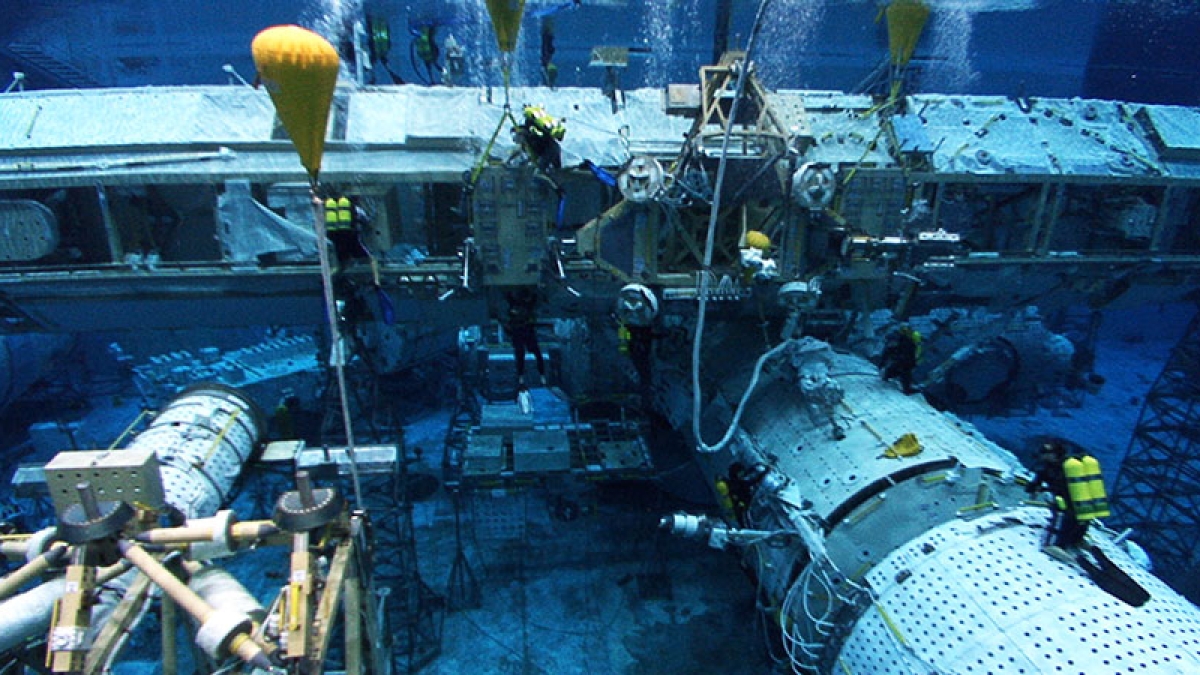
To simulate the movement challenges of microgravity, astronauts use neutral buoyancy training in massive pools. One of the best-known examples is NASA’s Neutral Buoyancy Laboratory, where astronauts practise working with full-scale mock-ups in carefully controlled underwater conditions.
The reason is simple: underwater neutral buoyancy is one of the closest practical ways on Earth to mimic the physical experience of weightless movement.
It is not exactly the same as space, of course. Water still creates drag, and the suit still behaves differently than it would in orbit. But as a training environment, it is remarkably effective.
That alone is enough to make most divers smile. Few things make scuba sound cooler than the fact that it helps train astronauts.
Both rely on suits and life-support systems
Scuba divers and astronauts do not just enter extreme environments. They bring their survival systems with them.
For divers, that means breathing gas, regulators, buoyancy control, exposure protection, and a system built around the underwater environment. For astronauts, it means a much more complex spacesuit that functions almost like a miniature spacecraft, managing pressure, temperature, oxygen, and protection.
The contexts are different, but the principle is similar. Neither diver nor astronaut can simply “be there” unprotected. They rely on engineered systems to stay alive and functional.
Both need to stay calm and procedural
There is also a psychological overlap.
Good divers are not defined by bravado. They are defined by calm, awareness, and an ability to follow procedure even when conditions become uncomfortable or unfamiliar.
The same mindset matters in space operations. Whether underwater or in orbit, panic is unhelpful, small mistakes can escalate, and clear decision-making matters far more than ego.
This is one reason scuba diving often appeals to people who enjoy discipline and focus. It is adventurous, yes, but it is also methodical.
Pressure matters in both worlds
This is where the comparison gets even more interesting.
Divers are familiar with the idea that pressure changes affect the body. As depth increases, ambient pressure rises. As divers ascend, pressure decreases. That is why ascent control and decompression awareness matter.
Astronauts face pressure-related risk too, but in the opposite direction.
When leaving a pressurised spacecraft for a spacewalk, they move into a much lower-pressure environment. That shift can also create decompression concerns if not managed properly. To reduce the risk, astronauts use carefully controlled protocols, including oxygen pre-breathing, to reduce nitrogen in the body before exposure to lower pressure conditions.
So while the mechanics differ, both divers and astronauts have to respect one core truth: pressure is not something you get to ignore.
The comparison is not exact, but that is part of what makes it interesting
Of course, scuba diving is not astronaut training in disguise.
Water has drag. Space does not. Diving introduces immersion, thermal loss, and a set of pressure effects that differ from orbital operations. Astronaut suits are vastly more complex, and the operational stakes in space are on another level entirely.
But the comparison still works because both activities sit within the broader story of human exploration. They require us to leave our natural environment, trust our equipment, and move carefully through places that are beautiful, hostile, and deeply humbling.
Insider insight
Part of what makes scuba diving so compelling is that it gives ordinary people a small taste of something extraordinary: entering a world where movement, breathing, and awareness all feel different. That sense of controlled alienness is one reason the comparison with astronauts resonates so strongly.
So, does being a diver put you on the path to becoming an astronaut?
Not automatically.
Scuba diving alone does not make someone astronaut material, but it does build qualities that overlap with the kind of mindset high-performance exploration demands: comfort in unusual environments, procedural discipline, composure, and equipment familiarity.
At the very least, it gives divers a fun way to appreciate just how serious astronaut training really is.
And it is probably enough to let you joke, at least a little, that you and astronauts do have something in common.
Common Questions
Do astronauts have to be scuba certified?
Not necessarily in the recreational sense, but underwater training and water-based operations are a meaningful part of astronaut preparation in many programmes.
Why is underwater training used for space?
Because neutral buoyancy is one of the best Earth-based ways to simulate the movement challenges of working in microgravity.
Can divers get decompression sickness and astronauts too?
Yes. Divers risk it when ascending from depth. Astronauts can also face decompression-related risk when transitioning from a pressurised environment to a lower-pressure one without proper preparation.
Is scuba diving similar to being in space?
Only in certain ways. The environments are very different, but both require life-support systems, procedural discipline, and adaptation to unusual physical conditions.
Final thought
Scuba divers and astronauts may head in opposite directions, but both are part of the same human instinct to explore beyond what is familiar.
One explores the silent world below. The other reaches into the darkness above.
And somewhere in between sits a simple truth: whether underwater or in orbit, exploration depends on preparation, humility, and respect for environments far bigger than ourselves.