

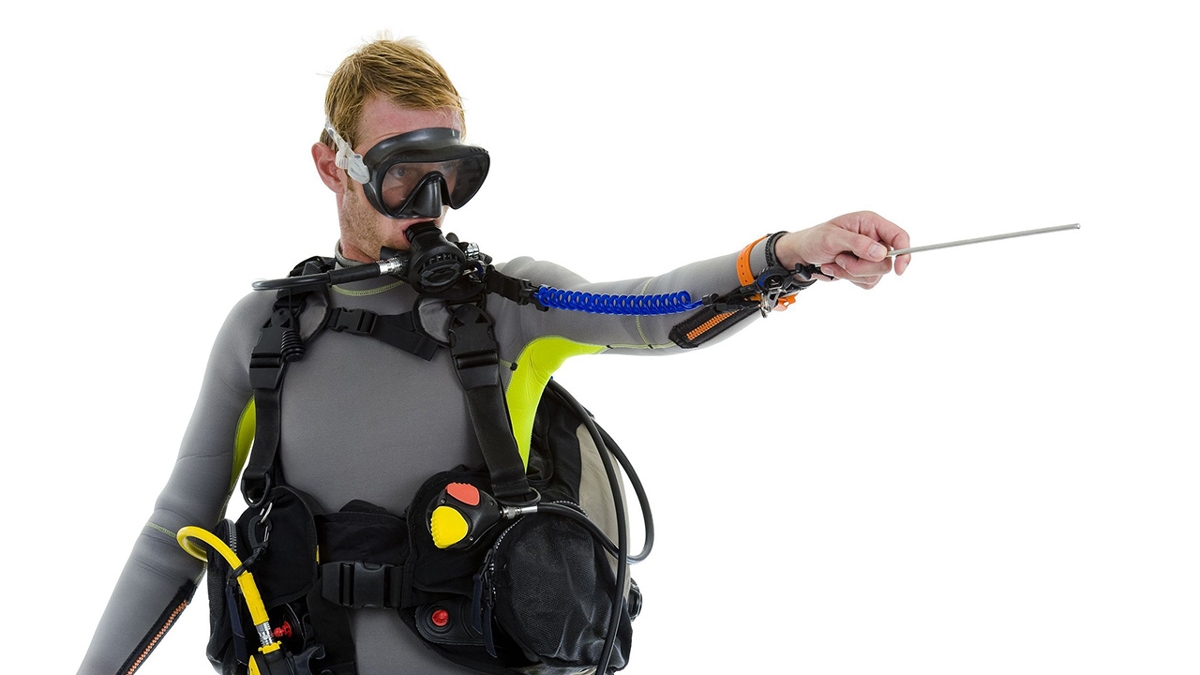
A scuba pointer is one of those small accessories many new divers notice early.
It looks simple, costs relatively little, and often seems to appear in the hands of dive guides, instructors, and underwater photographers. Depending on who you ask, it may also be called a muck stick, tank banger, reef stick, or something less elegant.
But before buying one, it helps to understand what it is actually for and where divers often get it wrong.
Because while a scuba pointer can be genuinely useful, it can also become an excuse for poor habits if used carelessly.
This guide is intended for:
- New and developing divers who want to understand what a scuba pointer does, when it may be appropriate, and how to use one without treating the reef as a handrail.
Key Takeaways
- A scuba pointer is a secondary tool, not an essential shortcut
- It can be useful for signalling, pointing out marine life, and managing certain dive situations
- It should never be used to harass marine life or compensate for poor buoyancy control
- Any contact with the reef or seabed should be avoided unless absolutely necessary and only where appropriate
- Good trim, buoyancy, and awareness matter far more than carrying a pointer
What is a scuba pointer?
A scuba pointer is typically a short metal rod carried by some divers as an underwater aid.
Its legitimate uses usually fall into a few categories: directing attention, making sound signals, and providing limited support in very specific conditions such as muck diving or certain current situations.
That said, the tool itself is neutral. The real issue is how it is used.
In good hands, it can be practical. In careless hands, it can encourage exactly the kind of reef contact and wildlife disturbance divers should be trying to avoid.
What a scuba pointer can be used for
1. Pointing out marine life
This is probably the most common use.
Dive guides often use a pointer to direct attention toward something small, well-camouflaged, or potentially hazardous without getting too close or placing hands near it. It can help show a seahorse, nudibranch, or stonefish while keeping a bit of distance.
The key point here is that the pointer should be used to indicate, not to prod.
2. Signalling underwater
Some divers use a pointer to tap their tank and get attention when needed.
This can be useful for alerting a buddy or group to something important, whether that is a safety issue, a change in plan, or occasionally an exceptional sighting. Like any signalling method, it should be used deliberately rather than constantly.
3. Limited use in muck or low-visibility diving
In some silty or sandy environments, experienced divers and photographers may use a pointer carefully in a clearly lifeless patch to steady themselves or avoid stirring up visibility-destroying sediment.
This is where nuance matters. Not every patch of seabed is empty, and many bottom-dwelling organisms are easy to overlook. So even in muck environments, contact should be treated cautiously, not casually.
4. Stabilising a camera setup in specific situations
Underwater photographers sometimes use a pointer as a stabilising aid when trying to hold position for a macro shot.
Again, this is not a free pass to plant metal into the reef. It should only ever be considered with high awareness, good control, and in places where no living substrate is being disturbed.
5. Occasional support in current-heavy conditions
In some current situations, a diver may be tempted to use a pointer for temporary stabilisation.
But this should be approached very carefully. It is not a substitute for proper current diving technique, and it should never become routine reef contact disguised as good practice.
What a scuba pointer is not for
This is the part that matters most.
It is not a buoyancy crutch
A pointer should never become your workaround for poor buoyancy, bad trim, or weak situational awareness.
If a diver constantly needs a metal stick to stop themselves from touching the reef, the real issue is not equipment. It is skill development.
It is not for touching or teasing marine life
This should be obvious, but it still needs saying. A pointer is not a tool for poking, moving, cornering, or provoking animals for a better view or photo.
It is not an excuse for more contact
Some divers tell themselves they are “protecting the reef” because they are touching it with a pointer instead of a hand or fin. That logic does not hold up well. Contact is still contact, and poor habits are still poor habits.
The environmental line: just because you can, doesn’t mean you should
The biggest problem with pointers is not that they exist. It is that they can normalise unnecessary contact.
This is especially important for new divers, because early habits stick. If someone learns to use a pointer as a default support tool, it can delay the development of the buoyancy and trim skills that matter much more over the long run.
A better mindset is this: use the pointer sparingly, intentionally, and only where it genuinely adds safety or practicality without creating harm.
Insider Tip
If you are still building buoyancy and trim, improving those skills will usually do more for your diving than buying another accessory.
When carrying a pointer may make sense
A pointer may make sense if you are:
diving regularly in muck environments
working toward underwater photography in appropriate conditions
diving with guides or in regions where tank signalling is commonly used
already comfortable enough in the water to use it as a precise tool rather than a crutch
For many casual recreational divers, especially beginners, it is not something you urgently need.
How to use a scuba pointer responsibly
Keep it clipped and secured
If it dangles, it becomes its own environmental hazard.
Use it intentionally, not constantly
A tool you keep reaching for without thinking is usually a sign that you are leaning on it too much.
Avoid contact unless truly necessary
And even then, only where you are confident no living substrate or small organisms are being harmed.
Never use it on marine life
Not for touching, not for directing behaviour, not for entertainment.
Keep working on buoyancy
A well-controlled diver simply needs less intervention from gear.
Common Questions
Do all divers need a pointer?
No. Many divers never carry one and dive perfectly well without it.
Is a pointer bad for the reef?
It can be if misused. The issue is not the tool itself, but whether it encourages unnecessary contact or poor behaviour.
Should beginners buy one right away?
Usually not. Most beginners benefit more from improving core diving skills first.
Is a pointer useful for underwater photography?
It can be, especially in macro or muck conditions, but only when used with care and strong environmental awareness.
Is tank banging with a pointer acceptable?
It is commonly done in some dive settings as a signalling method, but it should be used purposefully and not excessively.
Final thought
The humble scuba pointer is neither essential nor inherently bad.
It is simply a tool, and like most tools in diving, its value depends on judgment.
Used well, it can help in specific situations. Used badly, it can reinforce exactly the behaviours divers should outgrow.
So before thinking of it as must-have gear, it is worth remembering this: the best-controlled divers usually rely less on accessories and more on skill.